
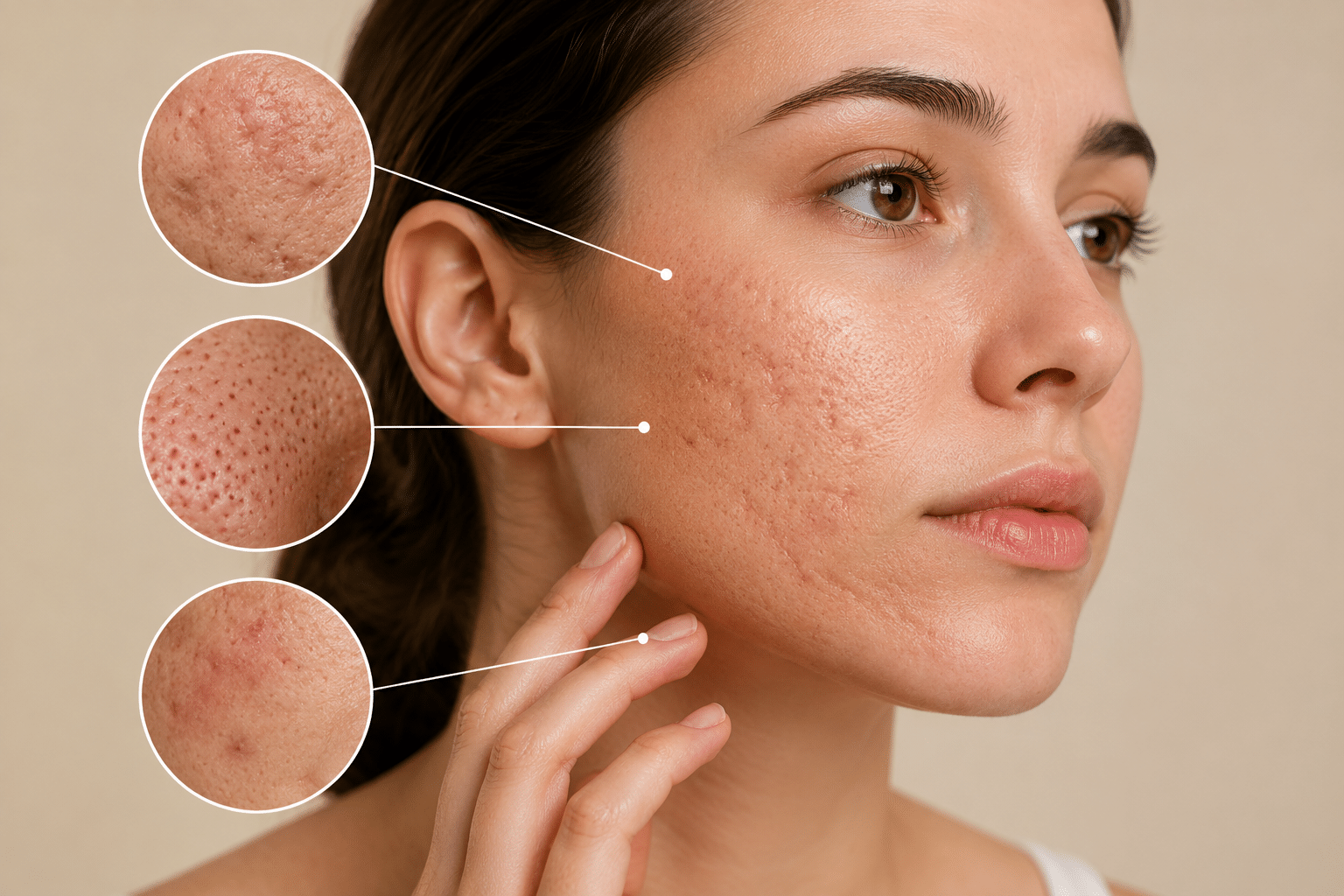
When people describe their skin as “textured,” they can mean very different things.
For one person, texture means enlarged pores around the nose and cheeks. For another, it means shallow depressions left after acne. Someone else may be concerned about roughness, fine lines or an uneven surface that becomes more noticeable under makeup.
Although these concerns can overlap, they are not identical.
Understanding what is causing the texture is important because different skin changes may respond to different approaches.
Before asking which resurfacing or collagen-stimulating treatment is best, start with a simpler question:
What am I actually seeing in my skin?
What Does “Uneven Skin Texture” Mean?
Uneven texture is an umbrella term.
It can describe skin that appears:
- rough
- bumpy
- pitted
- porous
- crepey
- dry
- scarred
- irregular
It may be caused by one issue or several at the same time.
For example, someone may have enlarged pores across the centre of the face, shallow acne scars on the cheeks and dryness around the mouth.
All three affect how smooth the skin looks, but they do not necessarily have the same cause.
Are Enlarged Pores Acne Scars?
No.
Pores are normal structures within the skin.
They can appear more noticeable because of factors such as:
- oil production
- genetics
- skin elasticity
- congestion
- ageing
- accumulated sun exposure
A visible pore usually appears as a small opening in the skin.
An acne scar is a structural change that occurs after inflammatory acne damages skin tissue.
The visual difference can be subtle, particularly when there are many shallow scars.
One useful clue is distribution. Enlarged pores often appear repeatedly in areas where sebaceous glands are more active, especially around the nose, inner cheeks and forehead.
Acne scars tend to correspond more closely with areas where inflammatory acne previously occurred.
What Do Atrophic Acne Scars Look Like?
Many facial acne scars are atrophic, meaning they create a depression in the surface of the skin.
They are commonly described using categories such as ice-pick, boxcar and rolling scars.
These terms describe appearance rather than severity.
Ice-pick scars
These tend to be narrow and relatively deep.
They may resemble a tiny opening or puncture in the skin.
Because they can extend deeper than their surface width suggests, they are different from a broad shallow depression.
Boxcar scars
These are wider depressions with more defined edges.
They may be shallow or deeper.
When several appear together, the cheek can take on a visibly uneven surface.
Rolling scars
Rolling scars tend to create broader, softer depressions.
Instead of sharp edges, they can give the skin a wave-like or undulating appearance, particularly under directional light.
Many people have a combination of scar types rather than one uniform pattern.
Why Does Lighting Make Acne Scars Look Worse?
Texture becomes more visible when light creates shadows.
That is why acne scars may seem relatively subtle when looking directly into a brightly lit mirror but much more noticeable:
- beside a window
- under overhead lighting
- in side lighting
- in photographs
- when applying foundation
Directional light emphasizes changes in depth.
This is also why evaluating a scar should involve more than looking at skin colour.
A flat brown mark from previous acne may be highly visible but produce no shadow.
An indented scar may be close to the surrounding skin colour but become obvious when light hits it from the side.
Is a Dark Acne Mark a Scar?
Not necessarily.
A flat red, purple, brown or grey mark can remain after an acne lesion heals.
If the surface of the skin has not changed, the concern may be primarily colour rather than structural scarring.
This distinction is important.
Pigment-focused treatments and texture-focused treatments do different jobs.
If someone assumes every post-acne mark is a scar, they may choose an unnecessarily aggressive approach.
Likewise, treating colour alone will not necessarily correct an indentation in the skin.
What About Red Marks After Acne?
Some post-acne marks appear red or pink rather than brown.
This can be related to vascular changes remaining after inflammation.
Again, this is different from an actual indentation.
A person may therefore have:
- post-inflammatory brown pigmentation
- persistent redness
- indented scars
- enlarged pores
all in the same area.
A good skin assessment separates those concerns before a treatment plan is created.
What Causes Enlarged Pores?
Pore visibility is influenced by several factors.
Oil production
People with oilier skin may notice more prominent pores because sebaceous activity can make pore openings more visible.
Genetics
Some people naturally have more noticeable pores than others.
Loss of skin firmness
As the skin’s structural support changes with age, pores may appear more obvious.
Congestion
Oil and debris within a pore can make the opening appear larger.
Photodamage
Long-term UV exposure can contribute to changes in skin texture and elasticity that affect the appearance of pores.
The goal is therefore rarely to “close” pores completely.
Pores are normal and necessary. A more realistic objective is improving how visible they appear and addressing factors that may be making the skin look rough or congested.
Why Does Skin Sometimes Feel Rough Without Visible Scarring?
Texture can also involve the outer surface of the skin.
Dryness, buildup of dead skin cells, irritation or an impaired skin barrier may make skin feel rough even when there are no deep scars.
Signs can include:
- flaking
- tightness
- dull appearance
- patchiness under makeup
- surface roughness
- sensitivity
In this situation, jumping immediately to an intensive procedure may not be appropriate.
Sometimes improving skincare and barrier health should come first.
What Is the Difference Between Resurfacing and Collagen-Stimulating Treatments?
This is where terminology becomes important.
“Resurfacing” generally refers to approaches intended to improve aspects of the skin’s surface and texture.
“Collagen stimulation” refers more broadly to encouraging remodelling within the skin.
Some procedures may involve both mechanisms to varying degrees.
At Arion, treatment options relevant to texture concerns include RF Microneedling (INFINI), Pixel RF Plasma Resurfacing, SUBLATIVE (E-MATRIX) and CO₂ Laser Resurfacing (eCO2 Plus).
These are not interchangeable treatments, and the presence of acne scars does not automatically mean every one is appropriate.
The choice depends on factors such as scar type, depth, skin type, downtime tolerance and treatment history.
What Is RF Microneedling Used for in a Texture Plan?
RF microneedling combines controlled microneedling with radiofrequency energy.
Rather than thinking of it simply as an “acne scar treatment,” it is more useful to understand where it may fit in a broader texture strategy.
A practitioner may consider RF Microneedling (INFINI) when concerns involve texture and collagen remodelling.
However, different types of acne scars respond differently.
A deep narrow scar is structurally different from a broad rolling depression, which is why treatment should be tailored rather than selected from a generic list.
Where Does Resurfacing Fit?
Resurfacing may be considered when the surface quality of the skin is a major concern.
Options available through Arion include Pixel RF Plasma Resurfacing and CO₂ Laser Resurfacing (eCO2 Plus).
The important distinction is that stronger treatment is not automatically better treatment.
A more intensive procedure may involve greater recovery, and treatment intensity should match:
- the condition being treated
- skin type
- desired improvement
- previous treatment history
- acceptable downtime
- risk profile
Treatment planning is about finding the appropriate balance, not simply choosing the most aggressive option available.
Can One Treatment Remove Acne Scars Completely?
People searching online often use phrases such as “remove acne scars permanently.”
That expectation needs to be approached carefully.
Scar improvement is generally more realistic than promising flawless skin.
Several factors influence the result, including:
- scar depth
- scar type
- number of scars
- age of the scars
- skin’s healing response
- treatment choice
- number of sessions
- aftercare
Some scars may improve more than others even on the same face.
A personalised plan should therefore focus on meaningful improvement rather than an unrealistic promise of total removal.
What If I Have Both Acne Scars and Large Pores?
That is common.
You do not necessarily need to choose which concern “counts.”
The more useful question is which problem contributes most to the appearance you want to improve.
For example:
- shallow cheek scars may be the dominant issue
- visible pores may be more noticeable around the nose
- pigmentation may be left from more recent acne
- active acne may still be occurring
If active inflammatory acne is still significant, controlling new breakouts may also be important before investing heavily in treatment of old scars.
Otherwise, new scars may continue to form while existing ones are being treated.
Should Active Acne Be Treated Before Acne Scars?
Often, active acne and acne scarring need to be considered together.
If someone continues to develop inflamed lesions frequently, the priority may include reducing active acne and preventing additional scars.
Trying to correct old scars without addressing ongoing breakouts can become an endless cycle.
This is why a consultation should include questions about:
- current acne activity
- recent breakouts
- medications
- skincare
- picking or squeezing
- previous acne treatment
- scar history
The skin’s current condition matters just as much as the scars left years ago.
Does Home Skincare Help With Texture?
Skincare can support skin quality, but its limitations should be understood.
A well-designed routine may help with:
- dryness
- congestion
- superficial roughness
- pigmentation
- overall skin appearance
Topical skincare cannot simply rebuild every type of established indented scar.
That does not make skincare unimportant.
It means skincare and procedures have different roles.
Maintaining healthy skin before and after treatment can also help support a more consistent overall plan.
What Questions Should You Ask at a Skin Consultation?
If acne scars or texture are your main concern, useful questions include:
- What type of texture problem do I have?
- Are these marks pigment, scars or both?
- What types of acne scars are present?
- Is active acne still contributing to the problem?
- Which treatment is being recommended, and why?
- What downtime should I realistically expect?
- How many sessions may be considered?
- What improvement is realistic for my type of scarring?
- How should I care for my skin before and after treatment?
- Are there reasons this treatment may not be suitable for me?
These questions create a more useful consultation than simply asking, “What is your strongest laser?”
Can Acne Scars Get Better on Their Own?
Colour left after acne can fade over time.
True structural scars are different.
An indentation caused by tissue loss usually does not disappear simply because the redness or pigmentation around it fades.
This can create an interesting effect: a scar may initially seem very noticeable because it is both red and indented. Months later, the colour improves, but the indentation remains.
That is why it can be useful to reassess the skin after active inflammation has settled.
Why an Individual Assessment Matters
Two people with “acne scars” may require completely different plans.
Person A may have mostly post-inflammatory pigmentation and a few enlarged pores.
Person B may have rolling and boxcar scars with little remaining pigmentation.
Person C may have active acne, dark marks and early scarring.
Putting all three on the same treatment schedule simply because they used the same phrase in Google would make little sense.
The purpose of a consultation is to identify those differences.
The Bottom Line
Uneven texture is not one condition.
Acne scars, enlarged pores, pigmentation, roughness and residual redness can all make skin look less smooth, but each contributes in a different way.
Start by determining whether the concern is primarily:
- colour
- pore visibility
- surface roughness
- structural scarring
- active acne
- or a combination
From there, a practitioner can discuss whether options such as RF Microneedling (INFINI), Pixel RF Plasma Resurfacing, SUBLATIVE (E-MATRIX) or CO₂ Laser Resurfacing (eCO2 Plus) fit the skin’s actual needs.
For people in Vancouver who are unsure whether they have acne scars, large pores or another form of uneven texture, an assessment can provide something a treatment menu cannot: a clear understanding of what is actually causing the concern.