
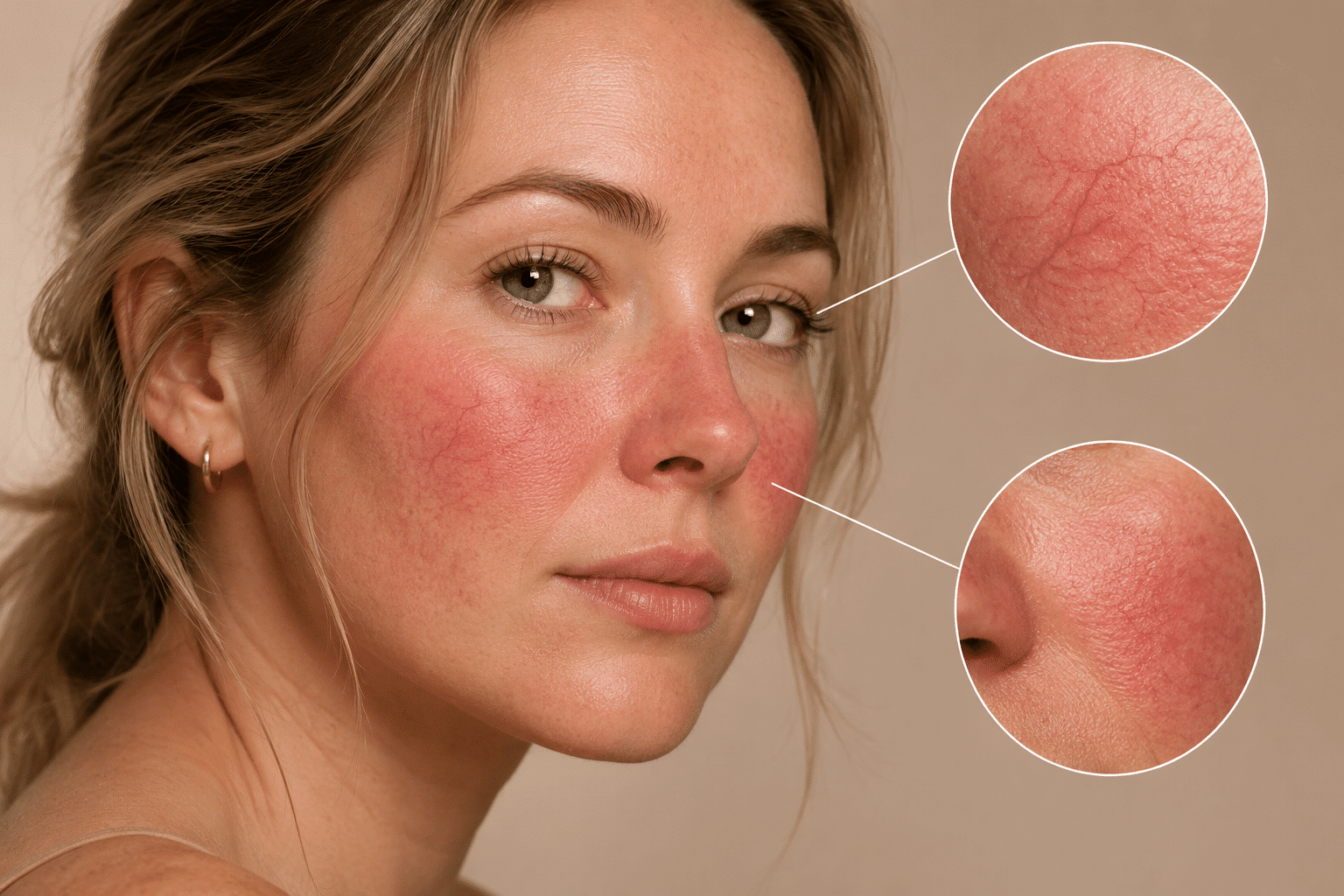
Seeing persistent redness on your face can be frustrating, particularly when it is difficult to determine what is causing it.
Is it sensitive skin?
Rosacea?
Broken capillaries?
Irritation from skincare?
Sun exposure?
A visible blood vessel?
These concerns can overlap, but they are not identical.
Understanding the difference matters because “red skin” is a symptom or appearance rather than one single condition.
Before looking for a treatment, it helps to identify the pattern.
What Is Facial Redness?
Facial redness simply describes visible redness of the skin.
It can be temporary or persistent.
Temporary redness can occur after:
- exercise
- heat
- cold exposure
- hot showers
- spicy food
- alcohol
- embarrassment
- skincare irritation
Persistent redness requires more thought.
It may be related to:
- rosacea
- chronic irritation
- visible superficial blood vessels
- inflammatory skin conditions
- sun damage
- an impaired skin barrier
- other medical causes
The location and behaviour of the redness provide useful clues.
What Are Broken Capillaries?
The phrase “broken capillaries” is commonly used to describe small visible blood vessels near the skin’s surface.
They may appear as:
- fine red lines
- branching vessels
- small web-like patterns
- isolated visible veins
Common areas include:
- sides of the nose
- cheeks
- chin
The vessels may remain visible even when the surrounding skin is not particularly red.
This is different from diffuse flushing, where an entire region becomes red without one individual vessel standing out.
Are Broken Capillaries Actually Broken?
The everyday term can be misleading.
What people call broken capillaries are generally visible superficial vessels rather than little vessels that have literally shattered beneath the skin.
The distinction is mostly terminology, but it helps explain why creams cannot simply “repair” a visible vessel in the same way a moisturiser can improve dryness.
When a vessel itself is the visible target, treatment planning may involve a vascular-specific approach.
Arion’s Clarity ( Nd:YAG / Alexandrite ) service is specifically associated with concerns including broken vessels, spider veins, telangiectasia, facial veins, redness, rosacea and broken capillaries.
What Is Rosacea?
Rosacea is a chronic inflammatory skin condition that commonly affects the central face.
Its presentation varies.
Some people experience primarily flushing and persistent redness.
Others may develop visible blood vessels.
Some experience inflammatory bumps that can resemble acne.
Because of this variability, rosacea should not be reduced to “red cheeks.”
A person can have rosacea without having exactly the same symptoms as another person with rosacea.
What Does Rosacea Redness Usually Look Like?
Common patterns can include redness affecting areas such as the:
- cheeks
- nose
- central forehead
- chin
Some people notice repeated flushing episodes before redness becomes more persistent.
Triggers can vary substantially between individuals.
Frequently reported triggers include:
- heat
- sun exposure
- spicy foods
- alcohol
- emotional stress
- hot beverages
- certain skincare products
Not everyone reacts to all of these triggers.
A useful strategy is to pay attention to your own patterns rather than following a long list of restrictions that may not apply to you.
Can You Have Rosacea and Broken Capillaries at the Same Time?
Yes.
This is extremely important when thinking about facial redness.
Rosacea and visible vessels are not mutually exclusive.
Someone can have background redness associated with rosacea and clearly visible superficial vessels around the nose or cheeks.
That means the treatment plan may need to consider more than one component.
Reducing the appearance of a visible vessel does not necessarily eliminate the underlying tendency toward rosacea-related flushing.
Likewise, managing rosacea triggers does not necessarily make an established visible vessel disappear.
How Is Irritated Skin Different From Rosacea?
Over-exfoliation and aggressive skincare can make the face look red, sensitive and inflamed.
This can sometimes resemble rosacea.
Clues that irritation may be contributing include:
- recent introduction of several active products
- frequent use of acids
- excessive scrubbing
- burning after applying skincare
- sudden sensitivity to products previously tolerated
- flaking or tightness
- redness that began after changing a routine
When the skin barrier is irritated, adding more active ingredients can make the situation worse.
If you are unsure whether you are experiencing rosacea, dermatitis or product irritation, professional medical assessment may be appropriate.
Why Is My Face Red After Washing It?
A face that becomes red after cleansing may be reacting to:
- very hot water
- rubbing
- a harsh cleanser
- fragrance
- over-cleansing
- existing sensitivity
Try paying attention to what happens when you use lukewarm water and a gentle routine.
Persistent burning, itching or inflammation deserves further assessment rather than continually experimenting with stronger products.
Can Sun Exposure Cause Redness?
Yes.
Sun exposure can contribute to both temporary inflammation and longer-term visible changes in the skin.
Repeated photodamage can also be associated with visible vascular changes and uneven tone.
This is one reason consistent sun protection is relevant even for people whose main concern is redness rather than brown pigmentation.
In Vancouver, cloudy weather can create a false sense that UV protection is unnecessary.
Daily protection remains relevant throughout the year.
Redness vs Pigmentation: How Can You Tell?
Uneven colour is not always pigment.
A quick visual distinction is that vascular redness tends to appear red or pink, whereas melanin-related pigmentation tends toward shades of brown, tan or grey.
But mixed conditions are common.
Someone may have:
- redness from visible vessels
- brown sunspots
- post-acne marks
- general photodamage
This mixture can make the complexion look “blotchy” even though several different processes are involved.
This is why treatments designed for pigment should not automatically be assumed to address vascular redness, and vice versa.
Where Does IPL Fit?
IPL stands for intense pulsed light.
Unlike a single-wavelength laser, IPL uses a range of light wavelengths.
Depending on the device, settings and patient, IPL technologies may be used within treatment strategies for aspects of uneven pigmentation and vascular appearance.
Arion offers SOLARI™ (IPL PHOTO FACIAL) as one of its face and body services.
Whether IPL or a vascular laser is appropriate depends on the individual’s skin, the type of redness and the target being treated.
This should be decided after assessment rather than solely from photographs online.
How Is a Vascular Laser Different?
A vascular laser is selected to target structures related to blood vessels.
Different wavelengths can interact differently with tissue and reach different depths.
This is one reason there is no universal “redness laser” that is automatically best for every visible vessel.
The size, depth, colour and location of the vessel can affect treatment selection.
Skin type also matters.
Arion’s Clarity ( Nd:YAG / Alexandrite ) technology includes an Nd:YAG component and is positioned by the clinic for several vascular concerns.
Can Skincare Remove Broken Capillaries?
Skincare can help support the skin barrier and reduce irritation, which may make the overall complexion look calmer.
But an established visible vessel is different from superficial dryness or inflammation.
A moisturiser does not physically remove a visible blood vessel.
That does not mean skincare is irrelevant.
A gentle routine may still be valuable for someone with redness, particularly if sensitivity or barrier irritation is also present.
The key is having realistic expectations about what topical products can and cannot change.
Can Rosacea Be Cured Permanently?
Rosacea is generally considered a chronic condition.
Management focuses on controlling symptoms and reducing triggers rather than promising a permanent cure.
Different people require different approaches.
Depending on symptoms, medical care may involve topical or oral medications, lifestyle adjustments and other strategies.
Aesthetic vascular treatments may be considered for appropriate visible vascular components, but they should not be confused with eliminating the underlying condition itself.
Should I See a Doctor for Facial Redness?
Persistent facial redness does not always require urgent medical care, but assessment is worthwhile when:
- redness is unexplained
- symptoms are worsening
- there is significant burning or discomfort
- the eyes are affected
- there is swelling
- a rash appears suddenly
- you suspect an allergic reaction
- you are unsure whether it is rosacea
- skincare changes have not helped
Medical diagnosis should come before cosmetic treatment when the cause is unclear.
What About Ocular Rosacea?
Rosacea can sometimes affect the eyes.
Symptoms may include irritation, dryness or other eye-related complaints.
Anyone experiencing persistent eye symptoms should seek appropriate healthcare assessment rather than relying on a cosmetic skin treatment.
This is another reason rosacea should be viewed as a medical skin condition rather than simply a cosmetic colour issue.
How Can I Track My Redness Triggers?
A simple diary can be useful.
For several weeks, note:
- weather
- sun exposure
- meals
- alcohol
- exercise
- stress
- skincare products
- hot showers
- flushing episodes
Patterns may become clearer over time.
You may discover that one suspected trigger has little effect while another consistently causes flushing.
This information can also make a professional consultation more productive.
Should You Treat Redness During an Active Flare?
This depends on the cause and treatment.
If the skin is actively irritated, inflamed or reacting to a product, the priority may be to calm the skin and determine what is happening before proceeding with an elective procedure.
A practitioner should assess the skin on the day of treatment and decide whether proceeding is appropriate.
Do not hide an active reaction simply because you do not want to postpone an appointment.
Can Redness Return After Vascular Treatment?
Yes.
Even when a treated visible vessel improves, new vessels can develop over time.
Underlying rosacea, genetics, sun exposure and other factors may continue to influence the skin.
This is why maintenance expectations should be discussed.
Think of vascular treatment as part of a longer-term skin-management strategy rather than a guarantee that facial redness can never recur.
Questions to Ask at a Redness Consultation
Consider asking:
- Does this look like diffuse redness or visible vessels?
- Could rosacea be involved?
- Should I get a medical diagnosis first?
- Which vascular structures are being targeted?
- Why is this particular technology appropriate?
- How many treatments may be considered?
- What will my skin look like afterward?
- What should I avoid before or after treatment?
- Is my skin type suitable?
- What result is realistic?
A good consultation should answer these questions clearly.
The Bottom Line
Facial redness, rosacea and broken capillaries are related but distinct concerns.
Facial redness is a broad description.
Rosacea is a chronic skin condition that can involve flushing, persistent redness, visible vessels and other symptoms.
Broken capillaries usually refers to individual superficial vessels that have become visible.
One person can have more than one of these at the same time.
For people in Vancouver researching persistent facial redness, the most useful first step is determining whether the visible problem is primarily diffuse inflammation, rosacea, individual vessels, irritation or a combination.
Once the pattern is clearer, options such as Clarity ( Nd:YAG / Alexandrite ) or SOLARI™ (IPL PHOTO FACIAL) can be discussed for appropriate candidates rather than treating every red complexion as the same condition.